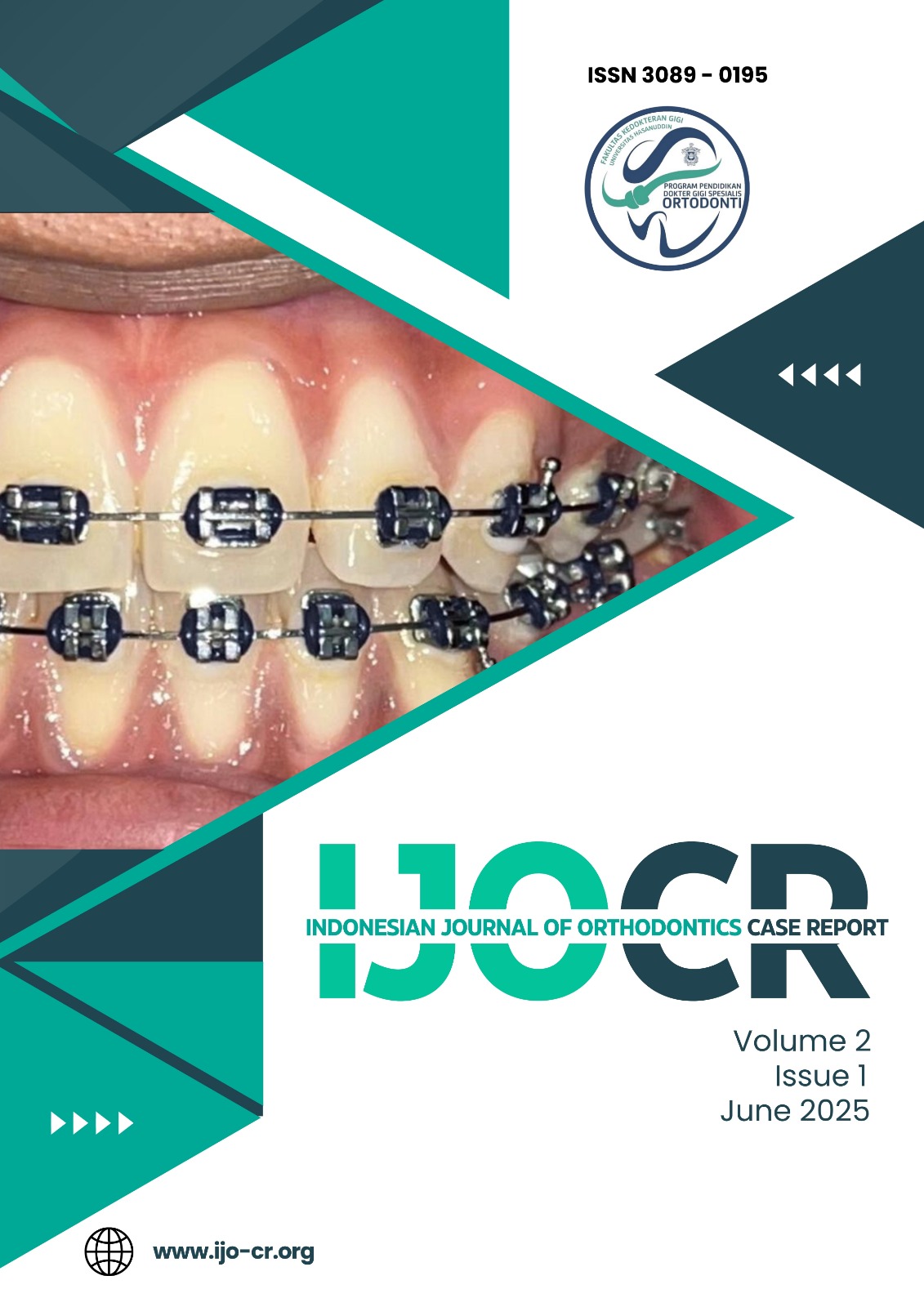
Orthodontic Management of Dentoskeletal Class I Malocclusion with Anterior Crossbite and Bimaxillary Crowding – A Case Report
Keywords:
anterior crossbite, bimaxillary crowding, dentalskeletal class 1 malocclutionAbstract
Introduction: Dentoskeletal Class I malocclusion is a common skeletal pattern characterized by normal anteroposterior jaw relationship but often accompanied by dental discrepancies such as bimaxillary crowding and anterior crossbite. These discrepancies can result in edge-to-edge bite, insufficient overjet, and functional disturbances, indicating the need for orthodontic intervention. Case Report: A 30-year-old patient presented with uncomfortable biting and protrusive incisors. Clinical examination revealed crowding in both arches, edge-to-edge incisor relationship, and a single-tooth anterior crossbite involving teeth 11 and 41. Radiographs confirmed skeletal Class I malocclusion with dental Class I type 1. Treatment involved a non- extraction approach using 0.022-inch MBT straight-wire appliance with interproximal reduction in the lower anterior teeth to create space for alignment and overbite correction. Discussion: After 17 months of treatment, the occlusion was harmonized with proper cusp contacts, anterior crowding was resolved, overbite increased from 0.5 mm to 1.5 mm, and overjet from 0.5 mm to 1 mm. Radiographs confirmed stable root positions and improved sagittal relationships. Functional and aesthetic outcomes were achieved without extractions, demonstrating the effectiveness of non-extraction MBT treatment in Class I malocclusion with crowding and anterior crossbite. Conclusion: Non-extraction orthodontic treatment using MBT brackets effectively corrected bimaxillary crowding and single-tooth crossbite in a dentoskeletal Class I patient, achieving stable, functional, and aesthetic results within 17 months.