Management of Orthodontic Camouflage Treatment in Class III Type 3 Subdivision Malocclusion: Case Report
Keywords:
Class III dentoskeletal malocclusion, Orthodontic camouflage, Inclined bite plane, Elastic class IIIAbstract
Introduction: Class III malocclusion is strongly influenced by genetic factors. Class III malocclusion can be treated in three ways: the first is growth modification, the second is camouflage treatment, and the third is orthognathic surgery. Orthodontic camouflage treatment can be performed for mild to moderate class III malocclusion case. Case Report: A 22-year-old female complained of his crossbite anterior. The family history of malocclusion showed characteristics of class III malocclusion. Cephalometric showed SNA 75o, SNB 80o, ANB -5o with overjet -1,5 mm, overbite 2,5 mm. This case was diagnosed as class III type 3 subdivision dentoskeletal malocclusion. The patient was treated with orthodontic camouflage treatment which was carried out by adjusting the inclination of the teeth using an inclined bite plane and class III intermaxillary elastic. After 20 months of treatment, facial profile changes were achieved (straight to convex), corrected anterior crossbite and posterior scissorbite, class I dental relations of canine and molar, 1 mm overjet, and 0,5 mm overbite. Discussion: Three approaches are available for treating class III dentoskeletal malocclusion and in this case, orthodontic camouflage treatment was performed by adjusting the inclination of the teeth using an inclined bite plane and class III intermaxillary elastic to achieve a good occlusion relationship.Conclusion: Orthodontic camouflage treatment for class III type 3 subdivision malocclusion provides optimal treatment results that are acceptable to patients and improves occlusion function and aesthetics.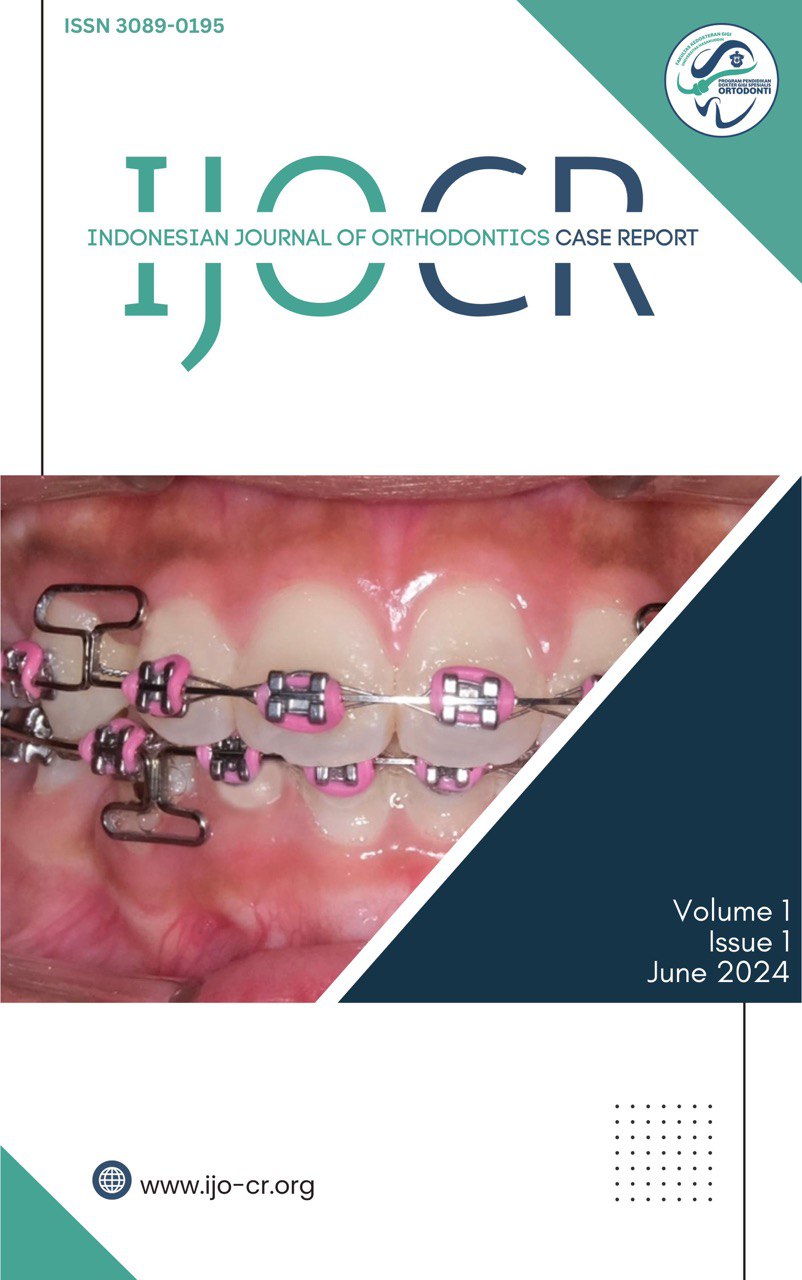
Downloads
Published
06/10/2024
Issue
Section
Articles