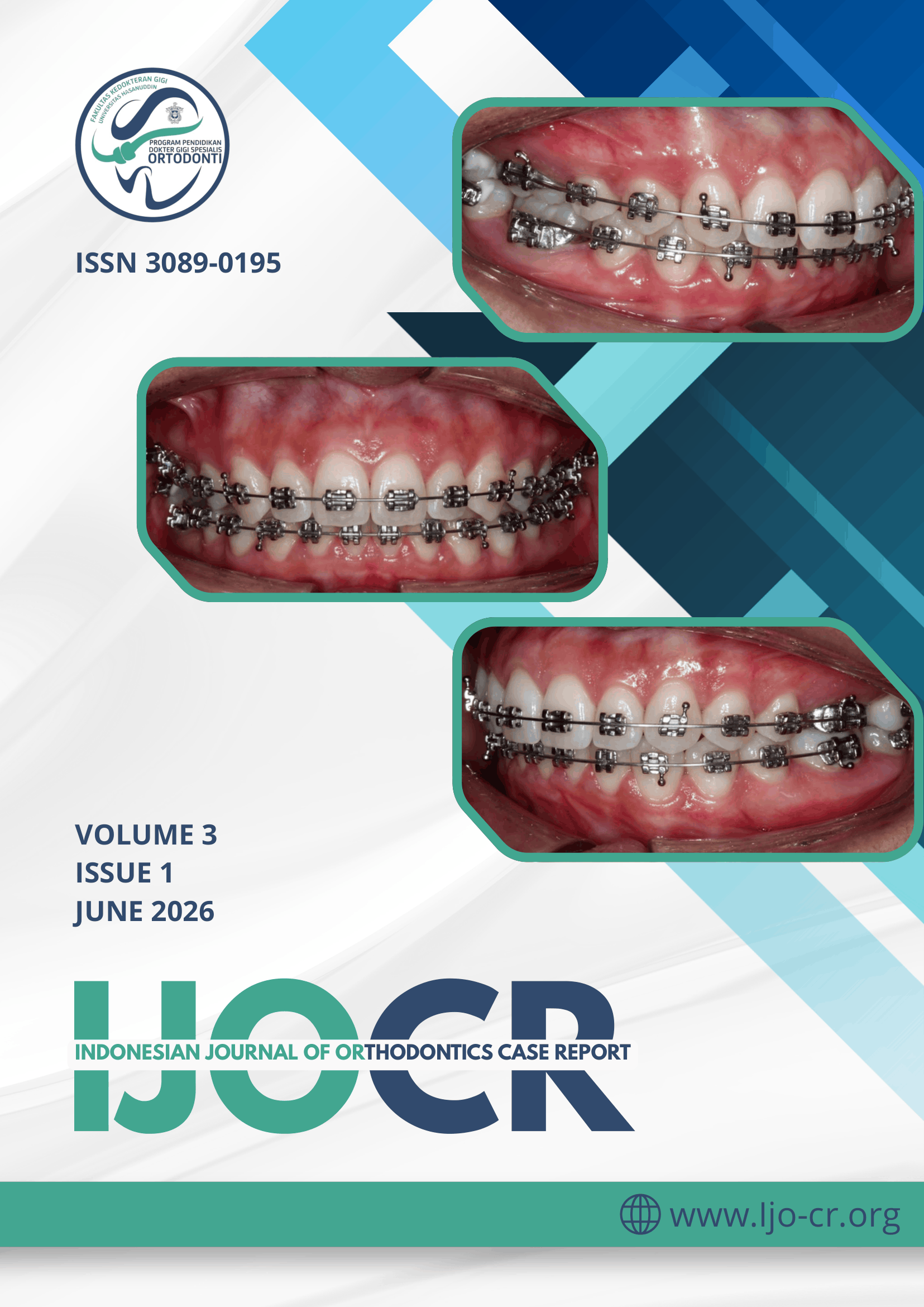
Orthodontic Management Of Transposition And Ectopic maxillary Canine - A Case Report
Keywords:
ectopic eruption, maxillary canines, orthodontic treatmentAbstract
Abstract
Introduction: The eruption path of the maxillary permanent canine is not only long and winding, but slightly buccal in relation to the dental arch. Moreover, its eruption occurs after that of the lateral incisor and the first premolar. Therefore, any approximation between the roots of these teeth decreases the space available for the canine and may cause their intraosseous retention or ectopic eruption, usually manifested by an exaggerated buccal position. Objective: the aim of this case report was to present the treatment of transposition and ectopic maxillary Case Report: A 15 years-old boy with chief complaint of misaligned teeth. Clinical examination revealed a convex facial profile with a unproportional lower third of the face, diminished nasolabial angle, showed canine displaced while smiling. The presence of the right and left maxillary primary canine was noted, as well as space deficiency in the maxillary arch of approximately —18 mm and severe crowding both of the anterior teeth in maxilla and mandible. Furthermore, the maxillary canines presented virtually superimposed buccal to the maxillary lateral incisors or nearly transposed. The patient was treated with 0.022-in Roth prescription brackets. Extraction of the 14, 24, 35, and 45 to reveal the crowding and corection the transposition and ectopic maxillary canine. Total treatment time was 15 months. On the day of debonding, a maxillary Hawley retainer was delivered Conclusion: Proper treatment of an ectopic canine patient with severe crowding requires careful treatment planning by the orthodontist. The decision to extract the premolars is to be good aesthetically, functionally, and for more stable results in these patients